Guide · Updated August 9, 2026 · 13 min read
Quarterly Estimated Taxes 2026: Deadlines, Safe Harbor, and How to Never Miss a Payment
Freelancers must pay estimated taxes four times a year. Here are the exact 2026 quarterly deadlines, how to calculate each payment, the safe harbor rule that protects you from underpayment penalties, and a simple system for never missing a due date again.
⚡ The short version
Pay 100% of last year's tax liability (or 110% if your prior year AGI was over $150,000) across the four deadlines, April 15, June 15, September 15, and January 15, and you will not owe underpayment penalties even if this year earns more. The simplest system that works: set aside 25 to 30% of every client payment into a separate account the day it lands.
In this guide
- 1. Who has to pay estimated taxes in 2026?
- 2. The four 2026 quarterly tax deadlines
- 3. How to calculate each quarterly payment
- 4. The safe harbor rule that protects you from penalties
- 5. What happens if you miss a payment?
- 6. How to set the right percentage for your situation
- 7. A simple system for never missing a payment
- 8. Common mistakes and how to avoid them
Who has to pay estimated taxes in 2026?
Anyone who expects to owe at least $1,000 in tax for the year after employer withholdings and credits, and who is not already covered by enough withholding, must pay estimated taxes. In practice that includes most 1099 contractors, freelancers, gig workers, side hustlers, landlords, and investors who sell stocks or crypto at a gain.
The IRS operates on a simple principle: taxes are due as you earn income, not once a year in April. Employees satisfy this automatically because employers withhold from every paycheck. When your income has no withholding, the IRS expects you to estimate and prepay four times a year instead. Ignoring that requirement does not avoid the tax, it just adds a penalty on top of the bill you owe anyway.
You probably owe estimated taxes if
- You worked as a freelancer or 1099 contractor last year and owed tax
- You run a side hustle in addition to a W2 job, and withholdings rarely cover the extra income
- You rent out a property and receive rental income with no withholding
- You sold stocks, crypto, or other assets and owe capital gains tax
- You received interest, dividends, or retirement distributions without withholding
- You are self employed full time and your entire income is untaxed at the source
The general rule is reliable: if you owed tax last year, you will probably owe estimated taxes this year. The IRS expects payment as you earn, so the safest habit is to treat quarterly tax as a non negotiable business expense from your very first freelance paycheck.
The four 2026 quarterly tax deadlines
Estimated taxes are due four times a year, and each payment covers income from a specific window. When a deadline falls on a weekend or federal holiday it shifts to the next business day, so the calendar date can move by a day or two in some years.
| Quarter | 2026 due date | Covers income earned |
|---|---|---|
| Q1 | April 15, 2026 | January 1 to March 31 |
| Q2 | June 15, 2026 | April 1 to May 31 |
| Q3 | September 15, 2026 | June 1 to August 31 |
| Q4 | January 15, 2027 | September 1 to December 31 |
Note that the windows are not even. The second quarter covers only two months while the fourth covers four, which is a quirk of the IRS calendar. For payment purposes you can ignore the windows entirely and simply pay one quarter of your projected annual tax each time, which is what most freelancers do and it is perfectly acceptable.
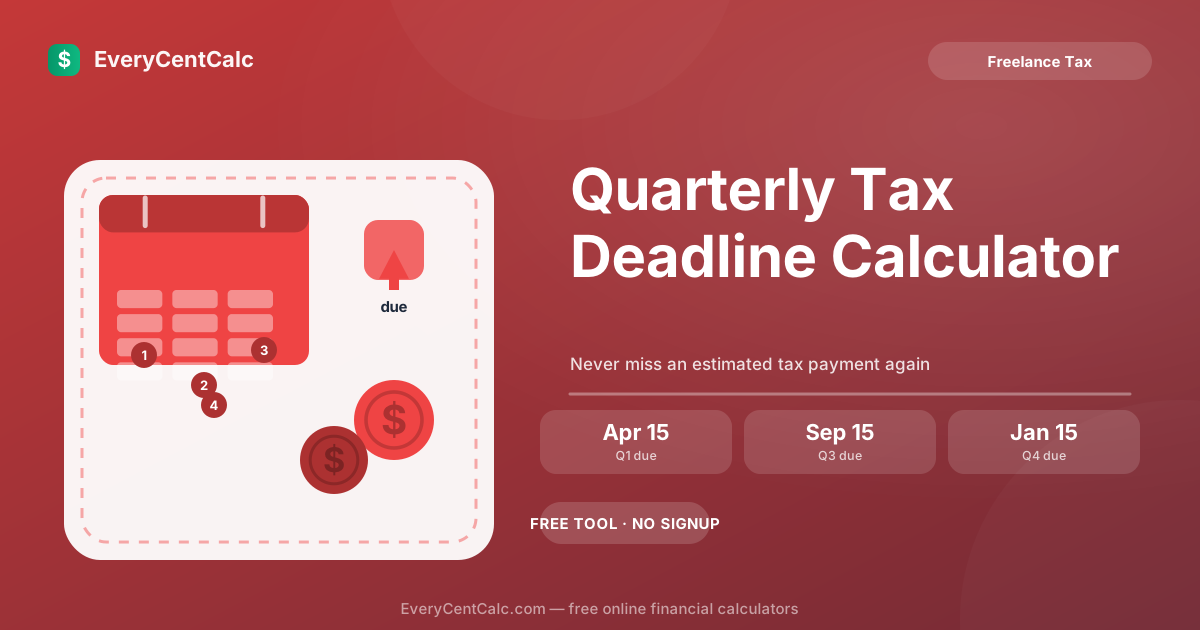
Deadlines shift when they land on a weekend or holiday. The quarterly tax deadline calculator shows the exact 2026 dates and how many days remain before your next payment, so you never guess wrong.
How to calculate each quarterly payment
The standard method is a four step projection: estimate your full year income, subtract deductions, compute the total tax for the year, then divide by four. It takes ten minutes and gives you a payment amount you can set on autopilot.
- Step 1: Estimate your total income for the year from clients, sales, gigs, rentals, and investments
- Step 2: Subtract business expenses, retirement contributions, and the QBI deduction
- Step 3: Add federal income tax and self employment tax together for your projected bracket
- Step 4: Divide the total by 4 and pay that amount by each deadline
If your income arrives unevenly, a big project in March and nothing in May, you can instead use the annualized method on Form 2210, which bases each payment on income actually earned during that specific quarter. It requires more paperwork but can prevent you from overpaying early in the year and locking up cash you need for expenses.
A real example keeps the math honest. Suppose you project $80,000 of freelance profit, expect $9,000 in deductions and retirement contributions, and land in the 22% bracket. Federal income tax on roughly $55,000 of taxable income is about $8,000, and self employment tax on the profit is about $11,200. Add them, subtract any credits, and your total for the year is roughly $19,200, so each quarterly payment is about $4,800.
The easiest path is to enter your recent paychecks and expenses into the quarterly estimated tax calculator. It projects your annual totals and splits the payment across each quarter automatically, with no manual bracket math.
The safe harbor rule that protects you from penalties
The IRS will not charge an underpayment penalty if your quarterly payments total at least 100% of last year's tax, or 110% if your prior year adjusted gross income was over $150,000, even when your actual tax for this year ends up much higher. This is called the safe harbor, and it is the most valuable number in your quarterly planning.
| Your prior year AGI | Safe harbor target | Alternative that also works |
|---|---|---|
| Under $150,000 | 100% of last year tax | 90% of this year actual tax |
| Over $150,000 | 110% of last year tax | 90% of this year actual tax |
The safe harbor is the lowest risk number you can pay because it does not depend on forecasting this year's income at all. If last year's tax bill was $12,000, paying $3,000 each quarter guarantees you owe no penalty even if this year's income doubles. That certainty is why knowing last year's total tax matters more than almost any other number in your planning.
The 90% alternative matters when you have a strong estimate of this year's income and it is clearly lower than last year's. In that case paying 90% of the lower actual tax is cheaper than paying 100% of last year's higher bill. Most freelancers use whichever target is smaller, and both are fully legal.
If last year's tax bill is available in your files, open it before you do anything else this quarter. It instantly tells you the minimum you can safely pay at every deadline.
What happens if you miss a payment?
The IRS charges an underpayment penalty on the amount you paid late and the number of days it was late, at roughly the short term federal rate plus 3 percentage points, compounded quarterly. It is calculated separately for each quarter, so a missed September payment is penalized independently of a missed January payment.
The penalty is an interest charge, not a fine, but it accrues daily and it compounds, so it quietly erodes your savings the longer you wait. If you fall behind, pay as soon as you can because every day of delay adds to the total. Then file Form 2210 to formally reconcile what you paid, and if your income was uneven, use the annualized method to see whether it lowers the penalty you owe.
There is also a separate late filing penalty that applies if you skip a whole deadline without paying anything at all, and it can be steeper than the interest on a partial payment. The combination is why catching up even one week late is always better than waiting until April to deal with everything at once.
The quarterly tax penalty calculator estimates exactly what a late payment will cost you, so there are no surprises at tax time and you can decide whether paying now or waiting is actually cheaper.
How to set the right percentage for your situation
The 25 to 30% rule of thumb works for most freelancers, but the right number depends on three variables: your income bracket, the size of your deductions, and whether you owe state tax. A freelancer earning $40,000 in a low tax state might only need 20%, while a six figure earner in California can need 35% or more.
- Under $30,000 profit: set aside 15 to 20%, most of it self employment tax
- $30,000 to $75,000 profit: set aside 25 to 30%, a mix of SE tax and income tax
- $75,000 to $150,000 profit: set aside 30 to 35%, higher brackets start to bite
- Over $150,000 profit: set aside 35% or more, and strongly review an S Corp election
- Add 2 to 5 points for high income tax states like California, Oregon, or New York
The percentage is just a starting point. What matters is that you recalculate it whenever your income jumps, because a 30% set aside on $50,000 of profit leaves you short if a single great month pushes you to $90,000 for the year.
Not sure what percentage fits your bracket? Work backward from the quarterly tax calculator for your income level, then round up a few points as a cushion. An overpayment becomes a refund; an underpayment becomes a penalty.
A simple system for never missing a payment
Missing a deadline is almost never a math problem, it is a system problem. The freelancers who pay on time every year do not rely on discipline, they rely on automation and separation. Here is the exact system that works.
- Set aside 25 to 30% of every client payment the day it lands, before it ever touches your spending account
- Put it in a separate savings account labeled Taxes so it never looks like spendable money
- Automate the transfer by percentage because most banks let you route a fixed share of deposits automatically
- Calendar every deadline the day it is announced, not a week before, because holidays shift dates
- Recheck your set aside rate each quarter since your bracket climbs as income climbs
- Pay through the IRS Direct Pay portal which takes two minutes and records your payment instantly
The psychology is the trick. Money that sits in your checking account will get spent, not because you are undisciplined but because every budgeting decision is easier when cash is visible. A separate tax account with an automated deposit makes the decision for you, and by tax time you are never scrambling for money you already spent.
Combine the system with the calculators on this page and you have a complete workflow: the quarterly tax calculator tells you the dollar amount, the deadline calculator tells you when, and the automatic set aside makes sure the money exists on both days.
Common mistakes and how to avoid them
- Paying from the wrong bank account and accidentally spending the money you set aside
- Using last year’s safe harbor but never updating it, which works until your income drops and you overpay for no reason
- Forgetting that state taxes are also due quarterly in many states, with their own separate deadlines
- Assuming the deadline is always the 15th, when weekends and holidays push it to the next business day
- Waiting until April to catch up, which converts a manageable quarterly bill into a penalty stack
- Ignoring the annualized method when income is back loaded, which makes you overpay all year for no reason
If this is your first year as a freelancer, note that the penalty can be waived for the first year if the shortfall was caused by reasonable cause. Claim it correctly with Form 2210 and keep the documentation that explains why you underestimated.