Guide · Updated August 9, 2026 · 13 min read
Rent vs Buy in 2026: The Honest Math That Decides It
Renting is not throwing money away. Whether buying wins depends on your price to rent ratio, how long you will stay, and what your down payment could earn invested. This guide shows the true cost of owning, the 5% rule, and how to find your break even date.
⚡ The short version
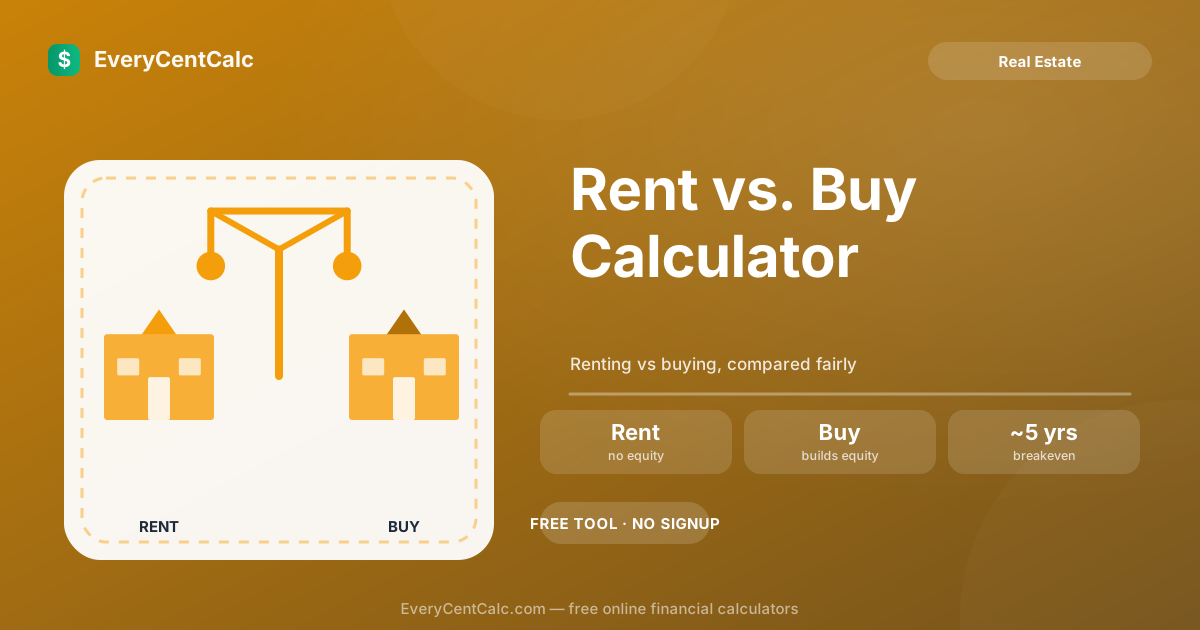
Use the 5% rule: if annual rent is less than 5% of the purchase price, renting usually wins, and if it is more, buying tends to come out ahead. Planning to stay under five years? Rent. Staying 7 or more years? Buying usually wins. Your break even date, not the mortgage payment, is the number that decides it.
In this guide
- 1. It is rent versus the true cost of owning, not rent versus mortgage
- 2. The opportunity cost of your down payment
- 3. The 5% rule of thumb
- 4. Why your time horizon decides the answer
- 5. Hidden costs that sink buyer budgets
- 6. When renting is genuinely smarter
- 7. How to run your own comparison in four steps
It is rent versus the true cost of owning, not rent versus mortgage
Comparing your rent check to a mortgage payment misses most of the picture. Owners pay property taxes, insurance, maintenance, HOA fees, and occasional big ticket repairs. Renters pay none of those directly, because the landlord absorbs them into the rent. The honest comparison nets all of those owner costs against the equity you build and any appreciation.
This is where most rent versus buy analyses go wrong. People look at a $2,400 mortgage payment and a $2,200 rent check, conclude the mortgage is barely more expensive, and decide to buy. They forget the $400 a month in property taxes, the $150 a month in insurance, the $250 a month in maintenance reserves, and the $12,000 in closing costs they paid on day one. Suddenly renting was the cheaper option all along.
The costs owners pay that renters never see
- Property taxes of 0.5 to 1.5% of home value every year, forever
- Maintenance budgeted at about 1% of the home value per year, plus big ticket reserves
- Homeowners insurance at several hundred to thousands of dollars a year
- HOA dues at hundreds a month in many communities
- Closing costs of 2 to 5% at purchase and 5 to 7% again when you sell
- Capital expenditures like roofs, HVAC, and appliances on their own unpredictable schedule
None of these are optional. A roof fails, an AC unit dies, and property tax reassessments happen whether you budgeted for them or not. The buyers who feel house poor are rarely the ones who overspent on the down payment, they are the ones who ignored the ongoing carrying costs until the first big repair arrived.
The opportunity cost of your down payment
A 20% down payment on a $400,000 home is $80,000 tied up in your house. Invested in a diversified index fund at a long run 7 to 10% return, that same $80,000 could earn roughly $5,600 to $8,000 a year. Your home appreciation on that same equity might be 3 to 4%, and you cannot easily touch the money without refinancing or selling.
That difference is the opportunity cost of your down payment, and it is the most ignored number in the entire decision. A house that appreciates 3% on $80,000 of equity is working at half the rate of the same money in a simple index fund. Over ten years that compounds into tens of thousands of dollars of difference, and it has to be paid out of the house value before buying can win.
Many rent versus buy analyses ignore opportunity cost entirely. Counting it flips the conclusion for a surprising number of buyers, especially in high priced markets where a large down payment sits idle in a slowly appreciating asset.
The 5% rule of thumb
A fast sanity check before you run the full math: the true annual cost of owning runs about 5% of the home value each year, roughly 1% property taxes, 1% maintenance, and 3% opportunity cost on your equity. Now compare that to your annual rent.
| Your situation | Usually smarter |
|---|---|
| Annual rent under 5% of the purchase price | Rent |
| Annual rent over 5% of the purchase price | Buy |
| Planning to stay under 5 years | Rent |
| Planning to stay 7 or more years | Buy |
| Down payment would earn more than home appreciation | Rent |
| You value mobility or minimal maintenance | Rent |
Worked out: a $400,000 home with annual rent of $18,000 has a price to rent ratio where rent is 4.5% of the price, slightly under the 5% threshold, so renting edges out on this rule. If the same home rents for $24,000 a year, that is 6% of the price, and buying looks smarter. The rule is a filter, not a verdict, but it is remarkably good at catching the obvious cases fast.
The 5% rule works best in stable markets and breaks down when appreciation is unusually fast or slow. Use it as a first filter, then run the real math for your price, rent, and rate.
Why your time horizon decides the answer
Buying is front loaded with one time costs: closing fees, inspections, and often 5 to 7% in total transaction costs that you will pay again when you sell. Amortizing those over two to three years usually leaves renting ahead, while over five to seven or more years ownership tends to pull ahead as the equity builds and the one time costs fade into the background.
- Under 2 years: renting almost always wins
- 2 to 5 years: likely renting wins, unless the market is unusually strong
- 5 to 7 years: the tipping point, so run the real numbers
- 7 or more years: buying usually wins on the math
If there is a real chance you will move for a job, family, or a city change within five years, renting is usually the lower risk play. The transaction costs of buying and selling are the heaviest weight in the decision, and the shorter your stay, the heavier they feel. Your break even date is the single most useful number in this entire decision.
A helpful way to think about it: every year you own the home you amortize the closing costs a little further, build a little more equity, and capture a year of appreciation. Every year you rent you keep the flexibility and the invested down payment. The break even date is the year those two lines cross, and past it, each additional year tips the scales more firmly toward buying.
When renting is genuinely smarter
- You value mobility and a new job, city, or lifestyle change is on the horizon
- Prices are stretched and price to rent ratios near historic highs favor renting
- You are not ready for maintenance because repairs, contractors, and weekend DIY are not free or fun
- Your down payment beats the house when market returns exceed likely home appreciation
- You would be house poor and ownership costs squeeze savings, investing, and emergency funds
- Your career is early and income is still growing faster than your housing needs are stable
None of that is shameful. Homeownership is a lifestyle choice as much as an investment. What is irrational is buying because rent is dead money when the numbers say otherwise, because renting is buying the option to relocate, invest, and avoid maintenance, and that option has real value that shows up in the math.
The most expensive mistake in this entire decision is making it emotionally. A house is the largest purchase most people ever make, and it is surrounded by family pressure, social norms, and the myth that renters are wasting money. The antidote is the same for everyone: run your own numbers, with your own down payment, your own rent, and your own time horizon, and let the break even date speak.
Run your own numbers, not the neighborhood. The rent vs buy calculator needs only your rent, price, down payment, and planned stay to give you a clear answer in under a minute.
How to run your own comparison in four steps
- Step 1, gather your numbers. Rent, purchase price, down payment, mortgage rate, planned years of stay, and expected appreciation.
- Step 2, estimate the annual cost of owning. Mortgage payments plus property tax, insurance, maintenance at 1%, and HOA.
- Step 3, add the one time and opportunity costs. Closing costs, plus what your down payment would earn invested each year.
- Step 4, compare totals over your planned stay. If owning is cheaper over that horizon and you can comfortably cover the cash flow, buying wins.
The comparison is only honest if it runs over your actual planned stay, because the first years of owning are dominated by transaction costs and the later years are dominated by equity and appreciation. A two year comparison and a ten year comparison of the same house can reach opposite conclusions, and both can be correct for their own horizon.
Pair the rent versus buy decision with the mortgage payment calculator for your exact payment, and the compound interest calculator to see what your down payment would grow to invested instead.